

A Business That Depends on Its Owner: Where Management Ends and Dependency Begins
In this article:
CSFB expert view: Business maturity is not defined by how little the owner is involved, but by which decisions genuinely require the owner's involvement.

In many small and medium-sized businesses in Turkey, the owner remains closely involved in sales, expenses, employees, customer relationships and key decisions.
At a certain stage, this is entirely normal.
The problem begins when the company grows but the management model does not.
There is a simple way to test this.
Imagine that the business owner does not answer calls or messages for one week.
Will payments still be approved? Will sales continue? Can the team handle an unusual customer issue? Will departments continue to work together?
Or will decisions quickly accumulate in one place under the same sentence:
“We need to ask the owner.”
High owner involvement is not the problem.
The problem begins when operational management depends on the constant presence of one person.
As the company grows, this model slows decision-making, discourages accountability and can eventually turn the owner into the main bottleneck of the business.
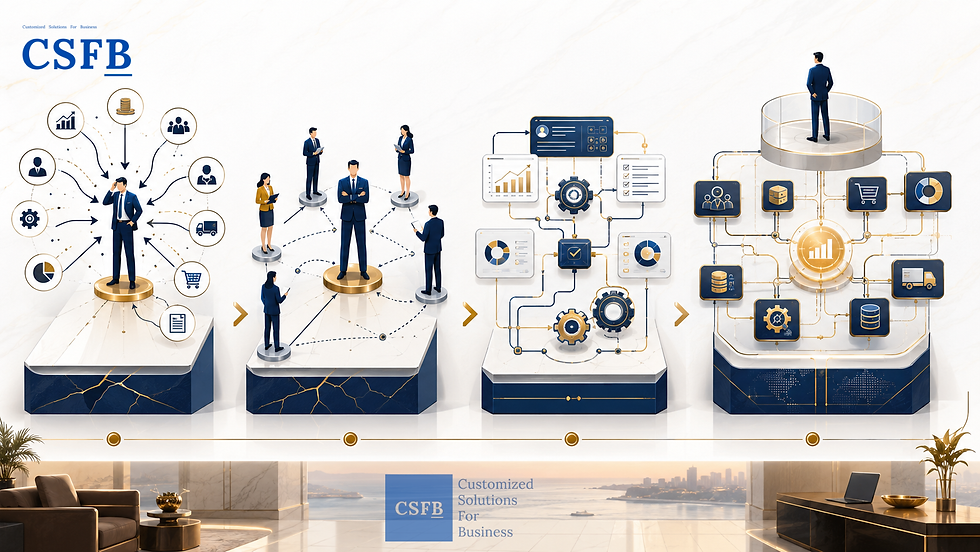
Four levels of business dependency
The development of a management system can be viewed through four levels.
Level 1. The owner
Critical information and key decisions are concentrated around the business owner.
Employees regularly wait for approval, and work slows down noticeably when the owner is unavailable.
This model can be efficient in the early stages of a company.
But as the business becomes more complex, the owner's personal management capacity starts to limit growth.
Level 2. Key employees
Some responsibility is transferred to experienced employees or department heads.
The company becomes less dependent on the owner.
But another type of dependency appears:
“Only this person knows how the process works.”
The risk has not disappeared. It has simply shifted from one person to several key employees.
Level 3. Business processes
Knowledge begins to move into CRM systems, procedures, sales workflows, approval rules and defined areas of responsibility.
The business becomes more stable and new employees can enter the system more easily.
However, documented processes alone do not create a management system.
If every exception still requires the owner's involvement, the company remains dependent on hands-on management.
Level 4. Management system
Roles, authority, business processes and management metrics are connected.
Employees understand not only what they are expected to do, but also which decisions they are authorised to make independently.
The owner remains in control of the business without becoming a mandatory participant in every operational process.
This is the transition from person-dependent management to a structured business management system.
Why delegation often fails
When an owner becomes overloaded with operational work, the most common recommendation is simple:
Delegate more.
But delegating tasks is not the same as delegating responsibility and decision-making authority.
A company may appoint a sales manager while the owner still approves every discount.
Marketing may be outsourced or delegated, while every campaign still requires personal approval.
An operations manager may be hired, but important decisions continue to flow back to the owner.
The organisational structure changes.
The decision-making centre does not.
That is why business systemisation should not begin with the question:
“What else can the owner delegate?”
More useful questions are:
Who is accountable for the result?
Which decisions can employees make independently?
Where does their authority begin and end?
Which management metrics should be monitored?
Which decisions genuinely belong at owner level?
For companies growing in the Turkish market, this becomes increasingly important.
A rise in customers, employees and business lines can quickly increase management complexity, even when the company itself still appears relatively small.
From hands-on management to a structured system
The goal of a management system is not to remove the owner from the company.
The goal is to stop using the owner's attention for decisions that should already be handled elsewhere in the organisation.
A manageable business usually rests on four basic elements:
clear areas of responsibility;
defined authority;
functioning business processes;
management metrics and control points.
The owner then stops monitoring every employee action and starts monitoring the business itself:
sales, financial performance, strategic priorities and critical risks.
This is the difference between controlling a business and managing every part of it manually.
When an external management perspective becomes useful
There is another difficulty.
It is often hard for the owner to redesign the management system while remaining inside the daily flow of operational decisions.
The owner may understand the business better than anyone else, but that same level of involvement can make recurring structural problems difficult to see.
Customer issues, employee decisions, payments and operational questions continually compete with strategic work.
At this stage, an external management perspective can be useful.
The purpose is not to run the company instead of the owner.
It is to help make the management structure clearer.
A management advisor can help identify:
which decisions should remain with the owner;
which authority can be transferred to the team;
where the business is overly dependent on individual employees;
which processes need to be redesigned;
which metrics are genuinely useful for management;
which recurring issues consume the owner's time but should be resolved elsewhere in the organisation.
The objective is not to create more procedures or more control.
It is to build a business that is more predictable, manageable and resilient.
Summary: If the owner stops responding for a week and the company stops functioning, the problem is not simply workload. The problem lies in the management architecture. A strong management system does not make the owner unnecessary. It removes the owner from decisions the organisation should already be capable of making without them. And it returns the owner's attention to the areas where it creates the greatest value: strategy, growth, capital and critical decisions.


Comments