

Systemic Marketing Architecture in 3-4* Hotels: Operational Routines That Guarantee Sustainable Revenue Growth
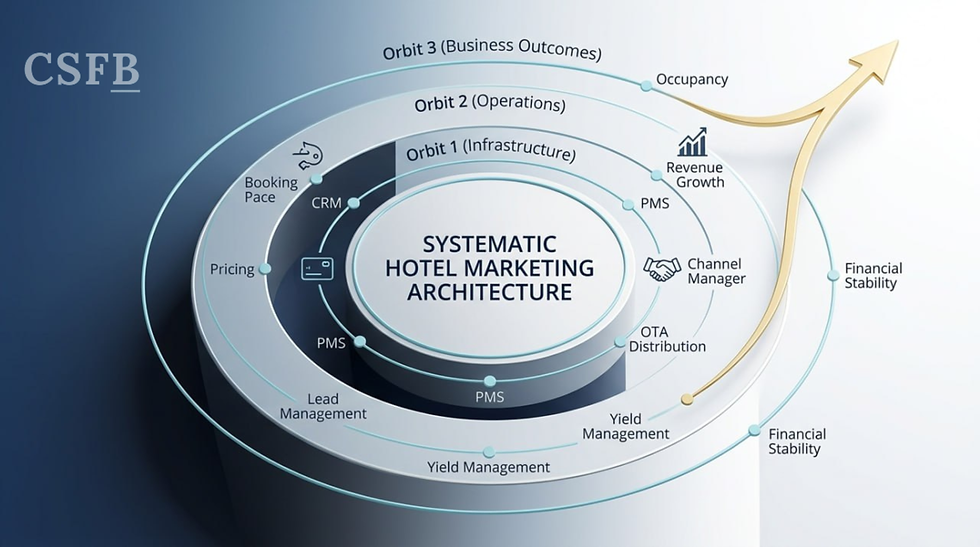
Most independent 3 and 4-star hotels operate in a permanent state of "extinguishing fires." When occupancy drops, management reacts by chaotically slashing rates, launching aggressive discounts, or pouring budgets into uncoordinated ad campaigns. However, sustainable commercial success in the hospitality industry is never the result of one-off tactical moves. It is the direct product of implementing a Systemic Marketing Architecture (Sistemli Pazarlama Mimarisi) and standard operational protocols.
Hotel performance should not be measured by accidental peaks, but by consistent, demonstrable, and structured results.
Below is the regular promotion management methodology that transitions hotel sales from a chaotic process into a highly predictable, systematic revenue engine.

1. The Stabilization Lag Effect (Booking Lag): Why the System Needs Time
When a hotel transitions from sporadic sales to systemic marketing, the business rarely sees an immediate spike in metrics during the first 60 to 90 days. In hospitality consulting, this phenomenon is known as the "booking lag effect." This initial stage is a period of deep restructuring of promotional and operational activities, without which long-term growth is impossible.
Key daily and weekly tasks during this foundational phase include:
Cleaning up the Channel Portfolio: Identifying and eliminating or renegotiating terms with low-margin, high-commission distribution channels that dilute the hotel’s profitability.
Establishing Rate Parity: Eradicating instances where third-party platforms display lower room rates than the hotel's official website.
Digital Ecosystem Synchronization: Ensuring seamless, end-to-end integration between the Property Management System (PMS), Channel Manager, and CRM software.
Only after completing this technical normalization will the accumulated marketing equity begin to give a positive upward movement in the sales funnel growth over the medium term.
2. Daily and Weekly Sales Operation Cycles
High occupancy during peak season is the mathematical consequence of routine micro-actions executed by the team every single day. Systematically managed hotels rely on the following mandatory protocols:
Daily: Algorithmic Yield Monitoring — Analyzing booking pace and automated adjustment of room rates every 4 to 6 hours based on real-time market demand shifts and competitor metrics (Dynamic Pricing).
Daily: CRM Lead Management — Instantly tracking and recovering abandoned bookings on the website, re-engaging potential guests using automated trigger scenarios.
Weekly: OTA Visibility & Performance Audit — Reviewing the hotel’s content score, review response rates, and listing health on Booking, Expedia, and other platforms to boost organic rankings.
Monthly: Cross-Sectional Data Analytics — Running Like-for-Like (LFL) and Year-over-Year (YoY) data reviews to statistically validate and calibrate the ongoing marketing strategy.
3. Managing Peak Demand: The 100% Occupancy Paradox
When a hotel reaches 100% occupancy weeks before a specific date, untrained owners celebrate it as an absolute triumph. A professional revenue consultant, however, recognizes a major red flag: revenue leakage.
If your inventory sells out too early, it means your baseline tariff grid was heavily underpriced relative to market demand. Yield Management requires the strict enforcement of a simple rule: as available inventory shrinks (e.g., when reaching the final 10-15% of room capacity), the system must automatically deploy “barrier” and elevated tariffs. This ensures the hotel captures maximum margins from last-minute bookings who are willing to pay a premium price.
4. Proactive Low-Season Insulation: Planning Winter in Summer
The greatest vulnerability for independent 3-4* properties is the severe dip in occupancy and cash flow during the winter months. A systemic approach dictates that low-season insulation strategies must be designed and taken to market during the summer — specifically in August and September.
Securing recurring B2B corporate loyalty contracts, designing long-stay packages tailored for digital nomads, and structuring early-bird booking infrastructure months in advance eliminates off-season operational risks and stabilizes cash flow year-round.
Conclusion: Systemic results in the real sector are not born from magic; they are the result of rigorous discipline and regular operational execution. The CSFB expert team builds autonomous marketing architectures that structurally transform vacant rooms into consistently growing, demonstrable bottom-line profit.


Comments